
 Written by
 Being the unexpected guests of a platoon of Guinean paramilitaries hadn’t been in our travel plans, but it turned out to be one of the highlights of our West African vacation — along with the spectacular scenery, abundant wildlife and the friendliness of nearly everyone we met.
Press enter or click to view image in full size

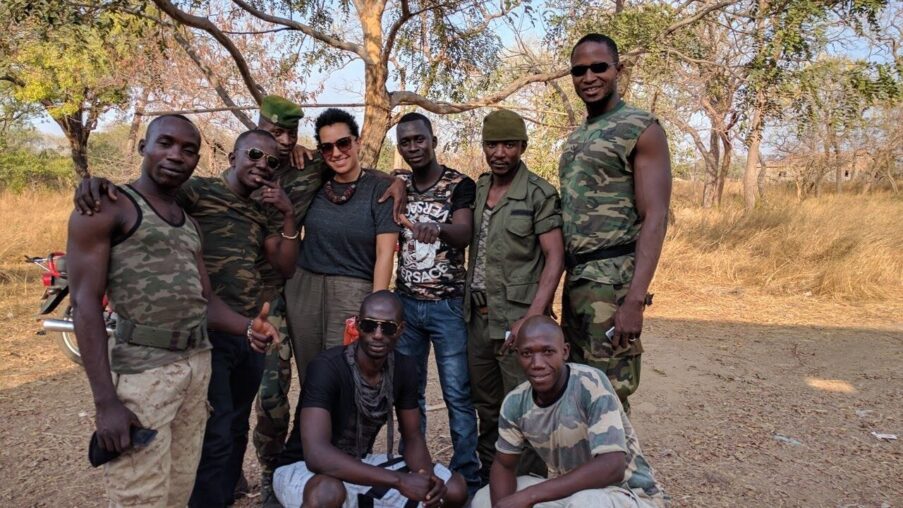
Tess with Guinean paramilitaries. Photo by Mart van der Niet.
We — my wife Carol, my niece Tess, two Dutch guys, Mart and Frederik; our British guide Simon, his assistant Bacary and our driver Khadry, both Senegalese— had been driving through the sun-baked countryside at a pretty good clip, grateful to finally be on a paved road, when suddenly came a loud thud, thud, thud, and we started swerving across the highway. Khadry expertly maneuvered our van to a stop at the side of the road.
It was our second flat of the day.
“This is Africa,” Simon had reminded us more than once. “There are always unanticipated problems, and somehow, there is always a solution.”
In this case, the problem was obvious. We were stuck in the middle of nowhere — or more precisely, northwestern Guinea, one of the poorest countries in the world, about 30 miles from the nearest town. The temperature was near 100 degrees, the sun was beating down mercilessly, we had no food, our supply of bottled water was nearly depleted, and our phones had no reception.
We were on our way back to Senegal after three days of hiking in Guinea’s spectacular Fouta Djallon highlands.
We had been traveling in relative luxury, in a hired van that seated the eight of us comfortably. (Except on the really rocky unpaved roads, where movement slowed to a crawl and the worst ruts sent jarring shockwaves up our spines.) The locals more typically travel between towns in ancient Peugeot station wagons, fitted with a third row of seats. In Senegal, these are called sept-places — seven places — because they squeeze in seven passengers, in addition to the driver. Plus an occasional chicken. In Guinea, they would be more appropriately called onze-, douze or treize-places, because it wasn’t uncommon to see four people squeezed into the front, four in the middle and three in the back, plus one or two on top of the luggage rack.
Press enter or click to view image in full size

Khadry jacked up the van, removed the wheel, and proceeded to flag down a sept-places. (Or in this case a huit-places or neuf-places, I didn’t count.) He and our rear wheel took off towards the next town, Koundara, with enough cash to buy a replacement tire.
Meanwhile, Mart, one of the Dutch guys, started walking towards a shade tree in the distance and a man came out to talk to him. He soon waved the rest of us over. We followed them to a nearby hut, where we were greeted by a platoon of soldiers in uniform. Lots of “Bon jour, ca va? Oui, ca va bien.”
They were, it turned out, Guinean soldiers serving a tour of duty as paramilitary park rangers, protecting the nearby national park from poachers. They came from all over Guinea, with different ethnicities and native languages, but as rangers, they were a cohesive unit, with a high level of camaraderie. Their efforts to stop poaching made them unpopular with the local villagers, who sometimes cast spells on them, involving poisons.
We had one awkward moment when one of the rangers announced his desire to marry Tess. We informed him that Tess was already married, (not really), which he accepted graciously. Tess produced a deck of cards, and for the next couple of hours, she and Carol played cards with a couple of the rangers. Neither side completely succeeded in explaining the rules of their favorite game to the other, but it didn’t seem to matter.
Press enter or click to view image in full size

Time passed quickly. It was market day in a nearby village, and one of the rangers gave me a ride on the back of his motorcycle to buy a case of water bottles. Both sides of the street were lined with makeshift stalls, selling everything from pots and pans to shirts to fresh tomatoes and peppers.
Back at the ranger station, a couple of the soldiers prepared a meal — frying chunks of fish over an open fire, then cooking it in a spicy sauce redolent with hot peppers and red palm oil. Though they had only enough to feed themselves, they fed us first, a big communal platter of rice topped with fish and sauce. It was delicious, but we ate sparingly, conscious of how many more mouths there were to feed.
After a few hours, Khadry reappeared with a new used tire mounted on the old rim. He mounted the wheel, we said our farewells to the rangers, and we were on our way. When we encountered them the next day in a nearby town, they greeted us like old friends.
It wasn’t the first time that we experienced West Africa’s famous hospitality. A few nights earlier, we arrived in the nearby town of Koundara at sunset, where Simon somehow tracked down a friend of a friend, a young man named Lamaran. Lamaran led us on his motorcycle from Koundara to his native village, where his extended family came out to greet us. They gave up their tidy mud hut homes to us for the night and fed us breakfast the next morning. Simon thanked them with a small payment before we left, but their hospitality still felt like a gift.
Press enter or click to view image in full size

In neighboring Senegal, this spirit of hospitality is called teranga, and is often described as the essence of Senegal’s culture. The national soccer team is even known as the Lions of Teranga. “Teranga is often translated as hospitality,” explains researcher Fedora Gasparetti, “but its implications stretch beyond the European notion of that word. The principle of teranga is to open your doors to any guest who may enter, to feed them, house them, and treat them as family for as long as they choose to stay…A Wolof proverb says that a guest is a king, and the Senegalese believe that the guest honours the host with his, or her, visit. Treating a guest well is a great source of pride for Senegalese women and men alike.”
In less than three weeks, crossing three countries, encountering multiple languages and cultures — Wolof, Diola, Mandinka and Fula (Fulani)— we could only scratch the surface. But it was enough time away from home to make me notice the oddness of the life I take for granted: the constant busy-ness, the endless distracting media spectacle, and above all, the unspoken assumptions that come into play when white people and black people encounter each other. There was something powerful about being in a culture where Blackness isn’t stigmatized.
Travel in West Africa isn’t for everyone, but if you have a spirit of adventure it can be an enormously rewarding experience. Here are just a few of the highlights of our visit:
- Trekking in the Fouta Djallon in northwestern Guinea. In the remote village of Doucki, Hassan Bah leads visitors from all over the world on hikes through spectacular scenery of waterfalls, mountain streams and spectacular vistas reached by climbing rope ladders up sheer cliffs. You can read more about our experience trekking in the Fouta Djallon here. Cost is around $25 a day, including housing in traditional Fulani thatched mud huts, delicious local cuisine, and guided tours. https://hikinginguinea.wordpress.com/about/
- Wildlife at the Wassadou lodge in the far east of Senegal. Baboons in the trees, green monkeys on the veranda. On an early morning boat ride on the Gambia river, you’ll see an amazing variety of birds, from red-billed hornbills and green bee-eaters to Abyssinian rollers and blue-breasted kingfishers. And hippos — though you will probably only see a pair of eyes sticking out above the waterline.
- Exploring the Casamance, the southwestern region of Senegal. Our guide, Simon Fenton, died tragically in a road accident shortly after our visit, but his widow, Khady, still lives in the village of Abene near the coast, with their two young sons, and still operates the Little Baobob guesthouse, a great place to stay if you visit Senegal. Khady cooks up delicious local dishes, and can arrange for you to go on birding hikes nearby, or walking treks through the Casamance delta. Saukou Jatta, a guide who works with Khady, can be reached at saikoujatta58@yahoo.com, +221-77101-4974.
- Exploring Dakar. Senegal’s cosmopolitan capital has it all — five star hotels and gourmet restaurants, and a vibrant music scene. Also, donkey carts, free-roaming goats, and longhorn cows wandering on the sidewalks. Shop the Marche HLM, where stylishly dressed Dakaroise women buy those beautiful African print fabrics — for a few dollars a yard. If you have time, have them tailored into dresses or shirts for a few dollars more.
- Visiting the House of Slaves museum on the Ile de Goree, a short ferry ride from Dakar. The untold part of the story of slavery is about the enduring social, cultural and economic devastation wrought on the communities they were abducted from.
Postscript: I learned with great sadness of the deaths of Simon Fenton and Khadry Diallo, a few months after this journey was completed. Khadry died in hospital in Ziguinchor of unidentified causes in early May. Simon died in a road accident in Senegal on May 26. A moving obituary for Simon can be found here.
If you go:
- Airfares from Minneapolis to Dakar are typically $1100-$1300, but occasionally as low as $699.
You don’t have to travel rough to experience West Africa. In the north of Senegal, you can find high-end beach resorts, and luxury cruises on the Senegal river. In Casamance, Cap Skirring has a Club Med, complete with golf course and tennis courts. But if you venture inland from the capital and the coast, those amenities quickly fall away. The best hotels might have a commode and a real shower, but toilet seats are a maybe, and in the villages, pit toilets are the norm.
The friendliness of nearly everybody will help you to overcome the language barrier, but it’s helpful to speak at least a little French.
Press enter or click to view image in full size

Press enter or click to view image in full size

Press enter or click to view image in full size

Press enter or click to view image in full size

Press enter or click to view image in full size

Press enter or click to view image in full size
Press enter or click to view image in full size

Press enter or click to view image in full size

Press enter or click to view image in full size

Press enter or click to view image in full size

Press enter or click to view image in full size

Press enter or click to view image in full size

Press enter or click to view image in full size
